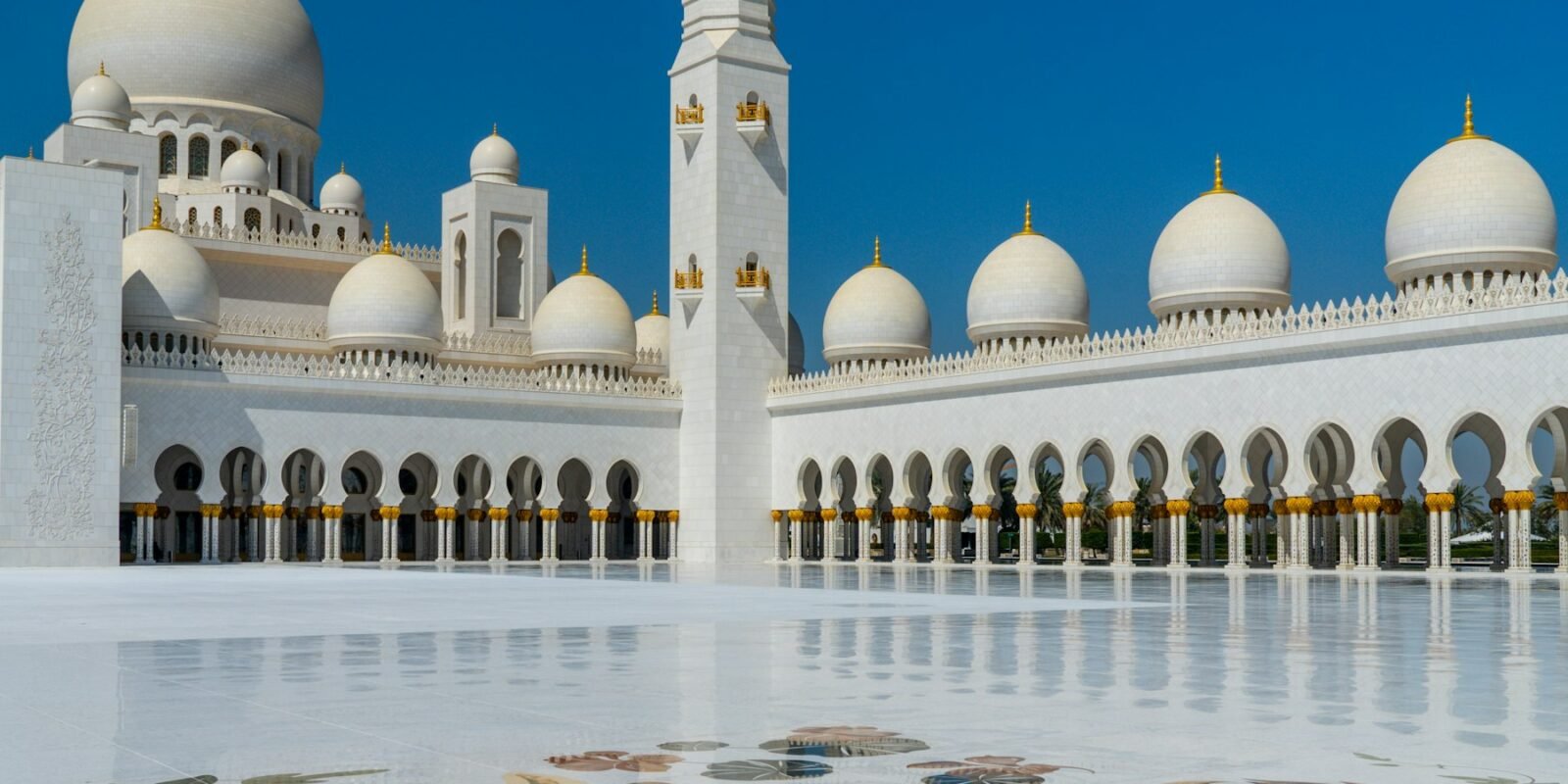
Few buildings stop visitors in their tracks the way the Sheikh Zayed Grand Mosque does. Its white marble domes and slender minarets rise above Abu Dhabi like something from a dream, glowing in the sun by day and lit in soft shades of blue and grey at night. Inside, the prayer hall shines with gold, crystal and coloured stone, and the floor is covered by one of the largest hand-knotted carpets in the world.
The mosque is a working place of worship, and it is also one of the most visited attractions in the UAE, welcoming people of all faiths every day. A visit is free, but there are clear rules on dress, behaviour and timing. This Sheikh Zayed Grand Mosque visitor guide explains everything you need to know: the dress code, opening times, how to register, what to see, photography rules, the best time to visit and how to get there from Dubai.
Tip: The easiest way to visit from Dubai is the Abu Dhabi City Tour from Dubai. Your guide handles registration, timings and the dress code check, and you see Qasr Al Watan, Heritage Village and the Corniche on the same day.
About the Grand Mosque
The Sheikh Zayed Grand Mosque was the vision of Sheikh Zayed bin Sultan Al Nahyan, the founding father of the UAE. He wanted a mosque that would bring together architectural styles from across the Islamic world and welcome people of every background. Construction began in the late 1990s and the mosque opened for worship in 2007. Sheikh Zayed is buried in a mausoleum next to the mosque.
Craftsmen and materials came from many countries, including marble from Italy, Greece and Macedonia, crystal from Germany, glass from Italy and the carpet from Iran. The result blends Mamluk, Ottoman, Fatimid and Moorish influences into one harmonious design.
The mosque in numbers
| Feature | Detail |
|---|---|
| Opened | 2007 |
| Domes | 82, of various sizes, covered in white marble |
| Minarets | 4, each about 107 metres tall |
| Columns | More than 1,000 |
| Capacity | Tens of thousands of worshippers |
| Main carpet | One of the largest hand-knotted carpets in the world |
| Chandeliers | Seven, decorated with crystals and gold-plated metal |
| Entry fee | Free |
Opening times
The mosque is open to visitors every day, usually from the morning until late evening, with some exceptions:
- Friday mornings: closed to tourists during Friday prayers. Visits usually resume in the afternoon.
- Prayer times: visitors may be asked to wait or avoid certain areas during the five daily prayers.
- Ramadan: visiting hours change during the holy month.
- Special occasions: the mosque may close at short notice for religious events or official visits.
Opening hours can change, so check the latest times before you go. If you visit with our tour, the guide plans the day around the mosque’s schedule.
How to register
Entry is free, but visitors are asked to register online before arriving and show their confirmation at the entrance. Registration is simple and takes only a few minutes. On a guided tour, this is handled for you.
The dress code
The dress code is the most important thing to get right. Visitors who do not follow it may be refused entry.
For women
- Loose, long clothing that covers the arms to the wrists and the legs to the ankles.
- A headscarf that covers the hair completely.
- No tight, short or transparent clothing.
- An abaya (a long, loose robe) is ideal.
For men
- Long trousers. Shorts are not allowed.
- Shirts or tops with sleeves. Sleeveless tops are not allowed.
- No tight or transparent clothing.
For children
Children should also dress modestly, with arms and legs covered. Girls from a young age are often asked to wear a headscarf.
Important: Do not rely on borrowing clothing at the mosque. Pack suitable clothes and a scarf in your bag, especially if you are coming straight from the beach or a theme park.
What to see
The approach and courtyards
Most visitors arrive through the underground visitor centre and walk up into the open. The first view of the white domes and the vast courtyard is breathtaking. The courtyard is paved with a floral marble mosaic that is one of the largest in the world, and reflective pools around the mosque mirror the arches and columns.
The columns and arcades
The arcades around the courtyard are lined with more than 1,000 columns, each inlaid with semi-precious stones in delicate floral patterns and topped with gold-plated palm-shaped capitals. Walking through the arches, especially in the late afternoon, is one of the most photographed experiences in the UAE.
The main prayer hall
The main prayer hall is the heart of the mosque. Look for:
- The carpet: a single enormous hand-knotted carpet, made by more than a thousand artisans, covering the floor of the hall.
- The chandeliers: seven chandeliers decorated with crystals and gold-plated metal, the largest of which is among the biggest mosque chandeliers in the world.
- The qibla wall: the wall that faces Mecca, decorated with the 99 names of God in Kufic calligraphy and lit with soft fibre-optic lighting.
The lighting at night
After sunset, the mosque is lit by a unique lighting system that changes the colour of the exterior according to the phases of the moon, from white to soft blue and grey. Visiting at sunset and staying into the evening lets you see the mosque in both daylight and its night colours.
Visit the Grand Mosque on a guided tour from Dubai
Islamic architecture: what to look for
Knowing a few architectural terms makes your visit far more rewarding. As you walk around, look out for these elements, all of which appear in the Grand Mosque.
- Minaret: the tall tower from which the call to prayer was traditionally made. The Grand Mosque has four, one at each corner of the courtyard, blending different regional styles.
- Dome: domes symbolise the vault of heaven. The mosque’s 82 white marble domes vary in size, with the largest over the main prayer hall.
- Sahn: the open courtyard in front of the prayer hall, used for prayer on busy days such as Eid.
- Qibla wall: the wall facing Mecca, which worshippers face during prayer.
- Mihrab: a niche in the qibla wall that shows the direction of prayer. Look for its gold and glass decoration.
- Minbar: the raised pulpit beside the mihrab from which the imam delivers the Friday sermon.
- Ablution areas: places where worshippers wash before prayer, a ritual of purification called wudu.
- Calligraphy: verses and the names of God written in elegant Arabic scripts, including the angular Kufic style and the flowing Naskh and Thuluth styles, decorate the walls.
- Floral motifs: Islamic art traditionally avoids depicting people and animals in religious spaces, so flowers, vines and geometric patterns are used instead. At the Grand Mosque, flowers inlaid in marble and stone appear almost everywhere.
Understanding prayer times
Muslims pray five times a day: at dawn (Fajr), midday (Dhuhr), afternoon (Asr), sunset (Maghrib) and night (Isha). The exact times change every day with the position of the sun. The call to prayer, the adhan, is broadcast from the minarets shortly before each prayer.
During prayer times, the main prayer hall is reserved for worshippers, and visitors may be asked to wait outside or stay in designated areas. Friday is the most important day of the week for congregational prayer, which is why the mosque is closed to tourists on Friday mornings. If you hear the call to prayer during your visit, simply move quietly and follow the guidance of staff.
Sheikh Zayed’s legacy
Sheikh Zayed bin Sultan Al Nahyan led Abu Dhabi from 1966 and was the first President of the UAE from its founding in 1971 until his death in 2004. He is remembered across the country as a wise, generous leader who united the seven emirates, invested in education and healthcare, and championed tolerance and respect between cultures. The Grand Mosque reflects these values: it was designed as a place where people of all faiths are welcome to learn about Islam and Emirati culture.
His mausoleum stands beside the mosque. Visitors can see it from the designated area, and recitations of the Quran take place there throughout the day. Please be especially quiet and respectful in this area.
The visitor centre
Most visitors enter through the visitor centre beneath the mosque, which has a welcome area, information desks, restrooms, cafés and a small shopping area with souvenirs, books and modest clothing. It is a comfortable place to cool down before or after your visit and to check that your clothing meets the dress code.
The mosque has often offered free guided cultural tours led by Emirati guides at set times during the day. These tours explain the architecture, the rituals of prayer and the history of the mosque, and they are an excellent way to understand what you are seeing. Check the latest tour times when you register.
Accessibility
The mosque is accessible for wheelchair users, with lifts, ramps and accessible restrooms, and wheelchairs may be available on request. Distances inside the complex are long, so guests with limited mobility should plan for a slower visit and take breaks. If you are visiting with our tour, tell us in advance so we can plan the drop-off point and pace.
A sample half-day in Abu Dhabi
If you have only a morning or an afternoon, this plan covers the essentials:
- Arrive at the mosque mid-morning or in the late afternoon.
- Spend 60 to 90 minutes exploring the courtyards, arcades and prayer hall.
- Drive to Qasr Al Watan for photos outside or a visit inside.
- Finish with a walk along the Corniche or, if it is evening, see the mosque lit up on your way back to Dubai.
Behaviour and etiquette
The mosque is a place of worship, so respectful behaviour is expected:
- Speak quietly and avoid shouting or running.
- Remove your shoes before entering the prayer hall. Shoe racks are provided.
- Do not touch the Quran or religious items.
- No eating, drinking or smoking inside the mosque.
- Avoid public displays of affection, including holding hands and hugging.
- Follow staff and signs about which areas are open to visitors.
- Do not disturb worshippers or walk in front of anyone praying.
Photography rules
Photography is allowed in most visitor areas, and the mosque is one of the most photogenic places in the world. A few rules apply:
- Photos must be respectful. Poses that are inappropriate for a place of worship are not allowed.
- Do not photograph people praying.
- Some areas may restrict photography; follow the signs.
- Professional equipment, drones and filming for commercial purposes need permission.
Photo tips
- Late afternoon light makes the white marble glow warm.
- Reflections in the pools at the edges of the courtyard make beautiful symmetrical shots.
- The arcades are best photographed looking down the line of columns.
- Blue hour after sunset shows the night lighting at its best.
Best time to visit
Time of day
- Morning: quieter and cooler, good for a relaxed visit.
- Late afternoon and sunset: the most beautiful light and the chance to see the lights come on, but busier.
- Evening: the night lighting is stunning and the air is cooler, especially in summer.
Time of year
October to April is the most comfortable season for walking around the courtyards. In summer, visit early in the morning or in the evening, and spend more time inside the air-conditioned prayer hall.
How to get there from Dubai
| Option | Details |
|---|---|
| Guided city tour | Hotel pickup in Dubai, guide, registration handled. Our Abu Dhabi City Tour starts from AED 180 |
| Cultural heritage tour | Adds entry to Qasr Al Watan and Qasr Al Hosn. See the Abu Dhabi Cultural Heritage Tour |
| Private transfer | Door to door from Dubai, about 1.5 hours. See Dubai to Abu Dhabi Private Transfer |
| Private car with driver | Set your own schedule for the day. See private car with driver |
| Public bus | Intercity buses to Abu Dhabi, then a taxi to the mosque |
The mosque is close to the main highway from Dubai, so it is often the first stop on a day trip.
Combining your visit with other sights
The Grand Mosque is the centrepiece of most Abu Dhabi day trips. Popular combinations include:
- Qasr Al Watan, the presidential palace, about 20 minutes away. Book a Qasr Al Watan ticket.
- Louvre Abu Dhabi on Saadiyat Island. Book a Louvre ticket.
- Yas Island theme parks, such as Ferrari World and SeaWorld.
- The Corniche and Heritage Village for a walk by the sea.
Read our full Abu Dhabi day trip from Dubai guide for itineraries.
Visiting with children
Children are welcome at the mosque, and many families visit together as part of a day in Abu Dhabi. Keep them close, explain beforehand that it is a quiet place of prayer, and make sure they are dressed modestly. Pushchairs can be used in many areas. The courtyards and reflective pools fascinate most children, and the visit can be kept to an hour if needed.
Visiting during Ramadan
Visiting during Ramadan can be a special experience. In the evenings, the mosque hosts large Iftar gatherings where worshippers break their fast together, and the atmosphere is warm and welcoming. Visiting hours change during the month, and eating or drinking in public during daylight is not allowed. Check timings before you go.
What to pack for your visit
A small, well-packed bag makes the day easier, especially if you are combining the mosque with other sights:
- A long-sleeved top and long trousers or a long skirt, or an abaya.
- A headscarf for women and girls.
- Socks, since you will walk barefoot or in socks inside the prayer hall and the marble can be hot or cold depending on the season.
- A water bottle to drink outside the prayer areas.
- Sunglasses and sunscreen for the courtyard, which has little shade.
- Your phone, charged, for photos and your registration confirmation.
- A copy of your passport or Emirates ID.
If you plan to visit Ferrari World or the beach on the same day, change into comfortable clothes afterwards rather than before.
Common mistakes visitors make
- Arriving on a Friday morning, when the mosque is closed to tourists.
- Wearing short sleeves or three-quarter trousers, which do not meet the dress code.
- Forgetting a headscarf, which is required for women.
- Not registering in advance if visiting independently.
- Taking disrespectful photos, such as jumping poses or posing in front of people praying.
- Rushing. The mosque is best enjoyed slowly, and the light changes beautifully through the afternoon.
More things to do in Abu Dhabi
Once you have seen the mosque, there is plenty more to discover in the capital. Take a mangrove kayaking trip in the Eastern Mangroves, enjoy dinner on an Abu Dhabi Corniche dhow cruise, or head into the dunes on an Abu Dhabi desert safari. For a longer stay, our Dubai and Abu Dhabi 6 Nights Package includes two nights in Abu Dhabi with the Grand Mosque and Ferrari World. You can also browse everything on our Abu Dhabi destination page.
Why the Grand Mosque matters to the UAE
For Emiratis, the Grand Mosque is more than a beautiful building. It is a national symbol of faith, hospitality and openness. Each year it welcomes millions of worshippers and visitors from all over the world, and it hosts major religious gatherings during Ramadan and the two Eid festivals. Its library holds rare books and manuscripts on Islamic sciences, art and history in many languages.
The mosque also plays a role in the country’s efforts to promote understanding between cultures. Its guides explain the meaning of prayer, the pillars of Islam and Emirati customs to visitors who may never have set foot in a mosque before. Many visitors leave not only with photos, but with a better understanding of the faith and culture at the heart of the UAE.
Day and night: two different experiences
If your schedule allows, try to see the mosque both in daylight and after dark. In the day, the white marble is dazzling against the blue sky, and the colours of the inlaid flowers and the gold details stand out. As the sun sets, the domes turn warm pink and gold, and then the night lighting takes over, bathing the building in cool shades that change with the phases of the moon. Many guests on our tours say the moment the lights come on was their favourite part of the whole day, and it is a wonderful way to end a trip to Abu Dhabi before the drive back to Dubai.
The easiest way to see both is to arrive in the late afternoon, explore the inside while it is still light, and stay in the courtyard or the reflective pools area until after sunset.
Frequently asked questions
Is the Sheikh Zayed Grand Mosque free to visit?
Yes. Entry is free for all visitors, but you should register online in advance and follow the dress code.
What is the dress code for the Grand Mosque?
Loose, long clothing covering arms and legs for everyone. Women must cover their hair with a scarf. Tight, short or transparent clothing is not allowed.
Can non-Muslims visit the Grand Mosque?
Yes. The mosque welcomes visitors of all faiths outside prayer times.
How long should I spend at the Grand Mosque?
Allow about one to one and a half hours to see the courtyards, arcades and prayer hall at a relaxed pace.
When is the Grand Mosque closed to tourists?
It is closed to tourists on Friday mornings during prayers and may close for special occasions. Hours also change during Ramadan.
Can I take photos inside the Grand Mosque?
Yes, in most visitor areas, as long as photos are respectful. Do not photograph people praying.
How do I get to the Grand Mosque from Dubai?
Join a guided Abu Dhabi city tour, book a private transfer or car with driver, or take an intercity bus and a taxi. The drive takes about 1.5 hours.